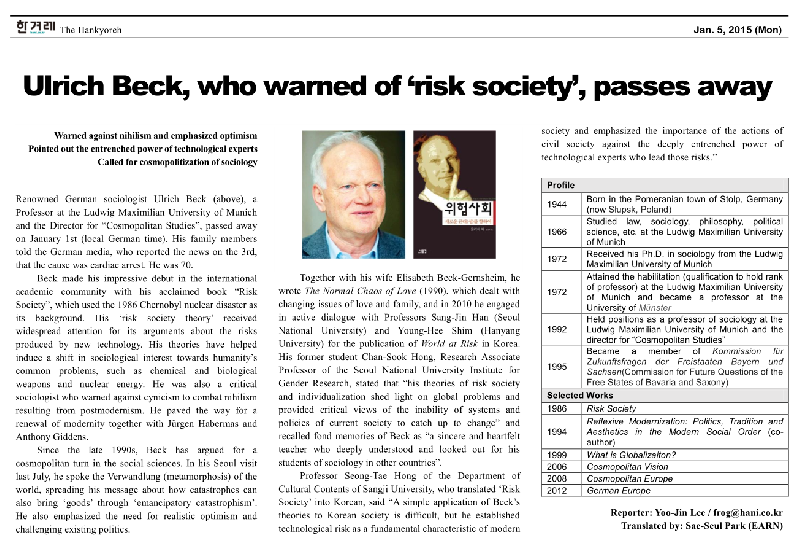
Ulrich Beck, who warned of ‘risk society’, passes away
The Hankyoreh | January 5, 2015
- Warned against nihilism and emphasized optimism
- Pointed out the entrenched power of technological experts - Called for cosmopolitization of sociology Renowned German sociologist Ulrich Beck
(above), a Professor at the Ludwig Maximilian University of Munich and the
Director for “Cosmopolitan Studies”, passed away on January 1st (local German
time). His family members told the German media, who reported the news on the
3rd, that the cause was cardiac arrest. He was 70. Beck
made his impressive debut in the international academic community with his
acclaimed book “Risk Society”, which used the 1986 Chernobyl nuclear disaster as
its background. His ‘risk society theory’ received widespread attention for its
arguments about the risks produced by new technology. His theories have helped
induce a shift in sociological interest towards humanity’s common problems,
such as chemical and biological weapons and nuclear energy. He was also a
critical sociologist who warned against cynicism to combat nihilism resulting
from postmodernism. He paved the way for a renewal of modernity together with
Jurgen Habermas and Anthony Giddens. Since
the late 1990s, Beck has argued for a cosmopolitan turn in the social sciences.
In his Seoul visit last July, he spoke the Verwandlung (metamorphosis) of the
world, spreading his message about how catastrophes can also bring ‘goods’
through ‘emancipatory catastrophism’. He also emphasized the need for realistic
optimism and challenging existing politics. Together
with his wife Elisabeth Beck-Gernsheim, he wrote The Normal Chaos of Love (1990), which dealt with changing issues
of love and family, and in 2010 he engaged in active dialogue with Professors
Sang-Jin Han (Seoul National University) and Young-Hee Shim (Hanyang
University) for the publication of World
at Risk in Korea. His former student Chan-Sook Hong, Research Associate
Professor of the Seoul National University Institute for Gender Research,
stated that “his theories of risk society and individualization shed light on
global problems and provided critical views of the inability of systems and
policies of current society to catch up to change” and recalled fond memories
of Beck as “a sincere and heartfelt teacher who deeply understood and looked
out for his students of sociology in other countries”. Professor
Seong-Tae Hong of the Department of Cultural Contents of Sangji University, who
translated ‘Risk Society’ into Korean, said “A simple application of Beck’s
theories to Korean society is difficult, but he established technological risk
as a fundamental characteristic of modern society and emphasized the importance
of the actions of civil society against the deeply entrenched power of
technological experts who lead those risks.”
|
Profile
| |
1944
|
Born in the
Pomeranian town of Stolp, Germany (now Słupsk, Poland)
| |
1966
|
Studied law,
sociology, philosophy, political science, etc. at the Ludwig Maximilian
University of Munich
| |
1972
|
Received his Ph.D.
in sociology from the Ludwig Maximilian University of Munich
| |
1972
|
Attained the
habilitation (qualification to hold rank of professor) at the Ludwig
Maximilian University of Munich and became a professor at the University of Munster
| |
1992
|
Held positions as a
professor of sociology at the Ludwig Maximilian University of Munich and the
director for “Cosmopolitan Studies”
| |
1995
|
Became a member of Kommission fur Zukunftsfragen der
Freistaaten Bayern und Sachsen(Commission for Future Questions of the Free States of
Bavaria and Saxony)
| |
Selected
Works
| |
1986
|
Risk
Society
| |
1994
|
Reflexive
Modernization: Politics, Tradition and Aesthetics in the Modern Social Order
(co-author)
| |
1999
|
What
is Globalizaiton?
| |
2006
|
Cosmopolitan
Vision
| |
2008
|
Cosmopolitan
Europe
| |
2012
|
German
Europe
|
Reported by: Yoo-Jin Lee
p.2 of January 5, 2015 / The Hankyoreh (attached)
Online Archive: http://www.hani.co.kr/arti/culture/religion/672085.html (in Korean)
Translated by: Sae-Seul Park (EARN) |












 94_1)2015.01.05_Hankyoreh (Ulrich Beck)_2_FINAL.pdf


